World Migratory Bird Day
By Prof. João Cabral.
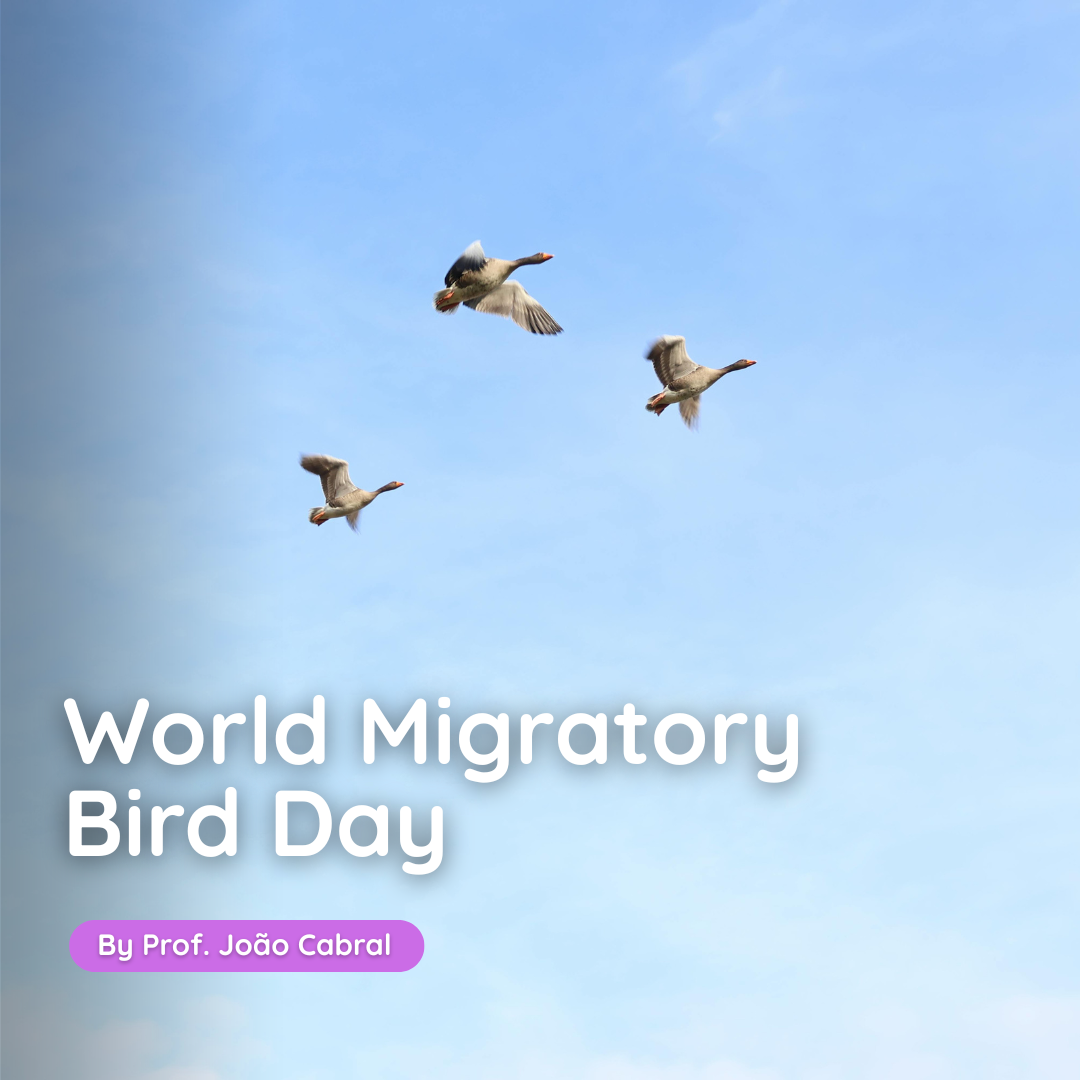
The World Migratory Bird Day aims to emphasize the crucial role of all countries that host migratory species in their global conservation. It is an international celebration established in 2006 by the United Nations Environment Programme (UNEP) under the Agreement on African-Eurasian Waterbirds (AEWA) and the Convention on the Conservation of Migratory Species (CMS). In this context, Portugal assumes its share of responsibility given its location in the middle of the East Atlantic migratory corridor, which connects the Arctic to West Africa. This corridor is used by 297 species of migratory birds, of which 70 species remain in Portugal during the breeding season (spring/summer). In addition to nesting migratory birds, Portugal also receives a large number of wintering bird species (which arrive from Northern Europe in the autumn/winter) and migratory passage species (species that can be observed in our country during the so-called "autumn migration" towards Africa).

Although more than 30% of these birds have a worrying threat status, the fact that this migratory corridor is under the jurisdiction of about 75 countries poses a huge challenge for its conservation. Habitat loss in areas severely impacted by human activities is one of the main threats. The LEAST network (Laboratory of Ecology Applied to Sustainable Territories), anchored at CITAB, is part of the URBACT Local Action Group (ULG) of Guimarães, a multi-sectoral body that supports the design, development and implementation of the Integrated Action Plan (IAP) of this Municipality. The IAP places ecological connectivity at the core of its vision for biodiversity conservation, naturally including migratory species, and the sustainable development of the Region. The LEAST network is also represented on the Scientific Committee of the European Green Capital (Guimarães 2026), where it held an approved project, PACTS2B-READY, which aims to contribute, through innovative technologies supporting decision-making in public policy, to mitigating the effects of habitat fragmentation, urban pressure, biological invasions, and climate change on the ecological integrity of the territory and the well-being of its community. PACTS2B-READY will pay special attention to ecological connectivity, in its structural (e.g., ecological corridors, habitat typologies, and green space networks) and functional (e.g., fauna dispersal, including migratory species, biodiversity refuge, primary productivity, hydrological regulation) dimensions, in the Municipality of Guimarães.
Start date: Saturday, 09th May 2026
End date: Saturday, 09th May 2026